


Mini gaming PCs in 2026 pack desktop-class performance into compact cases without sacrificing cooling or upgrade paths.
The GMKtec M6 Ultra and K11 deliver strong Ryzen multi-threading for games and content creation.
ROG NUC 2025 combines Core Ultra 9 with an RTX 5070 Mobile for high frame rates, while KAMRUI’s Hyper H1 and H2 handle sustained workstation loads.
BOSGAME P3 offers solid Radeon graphics and balanced I/O, so you can pick the mini that matches your gaming and creative needs.
| GMKtec M6 Ultra Gaming Mini PC Ryzen 7640HS |

| Versatile All-Rounder | CPU: AMD Ryzen 5 7640HS (6c/12t) | Memory (RAM): 32 GB DDR5 (2×16GB), expandable to 128 GB | Primary Storage: 1 TB M.2 2280 PCIe 3.0 SSD (installed) | VIEW LATEST PRICE | Read Our Analysis |
| ROG NUC 2025 Gaming Mini PC Core Ultra 9 |

| Ultimate Performance | CPU: Intel Core Ultra 9 (Series 2) ARL-HX | Memory (RAM): 32 GB DDR5 | Primary Storage: 1 TB NVMe SSD | VIEW LATEST PRICE | Read Our Analysis |
| KAMRUI Hyper H1 Mini Gaming PC Ryzen 7 |

| Creative Workhorse | CPU: AMD Ryzen 7 7735HS (8c/16t) | Memory (RAM): 24 GB LPDDR5 (5500 MHz) | Primary Storage: 1 TB M.2 2280 NVMe PCIe 3.0×4 SSD (installed) | VIEW LATEST PRICE | Read Our Analysis |
| GMKtec K11 Mini Gaming PC Ryzen 9 8945HS |

| Powerhouse Performer | CPU: AMD Ryzen 9 8945HS (8c/16t) | Memory (RAM): 32 GB DDR5 (dual-channel, 5600 MT/s), expandable to 128 GB | Primary Storage: 1 TB PCIe 4.0 M.2 2280 SSD | VIEW LATEST PRICE | Read Our Analysis |
| BOSGAME P3 Mini Gaming PC Ryzen 7 7840HS |

| Best for Gaming Value | CPU: AMD Ryzen 7 7840HS (8c/16t) | Memory (RAM): 32 GB DDR5 (2×16GB), expandable to 64 GB | Primary Storage: 1 TB M.2 2280 NVMe Gen4x4 SSD | VIEW LATEST PRICE | Read Our Analysis |
| KAMRUI Hyper H2 Mini PC - Intel Core 14450HX |
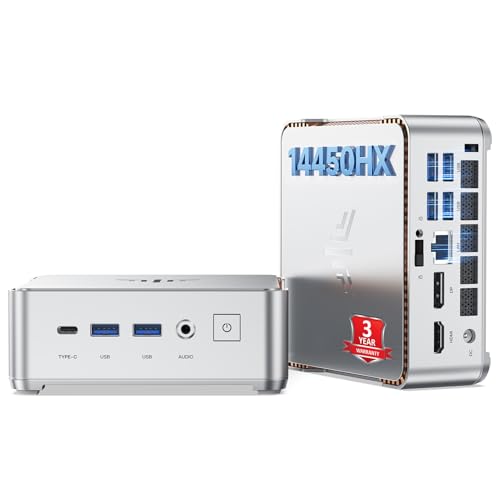
| Sustained Multi-Core Beast | CPU: Intel Core 14450HX (10c/16t) | Memory (RAM): 32 GB (16×2) dual-channel | Primary Storage: 1 TB NVMe PCIe 4.0×4 SSD | VIEW LATEST PRICE | Read Our Analysis |
More Details on Our Top Picks
GMKtec M6 Ultra Gaming Mini PC Ryzen 7640HS
If you want a compact PC that balances solid gaming and serious multitasking, the GMKtec M6 Ultra with the Ryzen 5 7640HS fits the bill. You’ll get six Zen 4 cores and 12 threads that sprint to 5.0 GHz, so games and apps feel snappy. Memory is generous with 32GB DDR5 and room to grow to 128GB, while a 1TB SSD keeps loads fast and quiet. The Radeon 760M handles moderate gaming and three displays smoothly. Plenty of ports and dual 2.5GbE help networking. You’ll appreciate the small size, solid performance, and friendly upgrade path.
- CPU:AMD Ryzen 5 7640HS (6c/12t)
- Memory (RAM):32 GB DDR5 (2×16GB), expandable to 128 GB
- Primary Storage:1 TB M.2 2280 PCIe 3.0 SSD (installed)
- Integrated/Discrete Graphics:AMD Radeon 760M integrated GPU
- Multi‑display Support / Video Outputs:Triple-display (USB4 up to 8K@60, HDMI2.0 4K@60, DisplayPort 4K@60)
- Networking (Ethernet & Wi‑Fi):Dual 2.5GbE RJ45 + Wi‑Fi 6 + Bluetooth 5.2
- Additional Feature:Dual 2.5GbE LAN
- Additional Feature:USB4 with 8K support
- Additional Feature:Expandable to 128GB
ROG NUC 2025 Gaming Mini PC Core Ultra 9
Gamers who want desktop-level power in a tiny package will love the ROG NUC 2025, because it pairs an Intel Core Ultra 9 ARL-HX processor with an NVIDIA GeForce RTX 5070 Mobile to handle big AAA titles and creative work without a full tower. You’ll notice fast frame rates and smarter power use thanks to up to 200+ platform TOPS and an 18% generation gain. The compact 3L chassis hides 32GB DDR5 and a 1TB NVMe SSD, with tool-free access for easy upgrades. Cooling uses three fans and dual vapor chambers, while ARGB lighting and Thunderbolt 4 keep it stylish and practical.
- CPU:Intel Core Ultra 9 (Series 2) ARL-HX
- Memory (RAM):32 GB DDR5
- Primary Storage:1 TB NVMe SSD
- Integrated/Discrete Graphics:NVIDIA GeForce RTX 5070 Mobile (discrete)
- Multi‑display Support / Video Outputs:Multiple display outputs + Thunderbolt 4 (supports external displays)
- Networking (Ethernet & Wi‑Fi):(High-end connectivity) Thunderbolt 4 and Wi/ethernet (ROG NUC series - premium networking)
- Additional Feature:NVIDIA RTX 5070 Mobile
- Additional Feature:ARGB Aura Sync lighting
- Additional Feature:Tool-free upgrade access
KAMRUI Hyper H1 Mini Gaming PC Ryzen 7
You’ll love the KAMRUI Hyper H1 if you want a tiny powerhouse that fits on a crowded desk and still runs creative apps and modern games smoothly. You get an AMD Ryzen 7 7735HS with eight cores and strong single and multi core speeds. It pairs with Radeon integrated graphics that handle Photoshop and video editing well. The system ships with 24GB LPDDR5 and a 1TB NVMe SSD, plus room for another M.2 drive. Triple 4K display outputs and 2.5Gb Ethernet keep you connected. Dual fans and a radiator keep it cool and quiet, and VESA mounting saves space.
- CPU:AMD Ryzen 7 7735HS (8c/16t)
- Memory (RAM):24 GB LPDDR5 (5500 MHz)
- Primary Storage:1 TB M.2 2280 NVMe PCIe 3.0×4 SSD (installed)
- Integrated/Discrete Graphics:Integrated AMD Radeon Graphics (Radeon frequency ~2200 MHz)
- Multi‑display Support / Video Outputs:Triple-display via DP1.4 + HDMI2.0 + USB3.2 Gen2 Type-C (each 4K@60)
- Networking (Ethernet & Wi‑Fi):2.5Gbps RJ45 Ethernet + Wi‑Fi 6 + Bluetooth 5.2
- Additional Feature:Auto Power On
- Additional Feature:VESA mount included
- Additional Feature:Dual M.2 slots
GMKtec K11 Mini Gaming PC Ryzen 9 8945HS
The GMKtec K11 puts desktop power into a compact box, making it ideal for players and creators who want top performance without a full tower, and its Ryzen 9 8945HS is a standout feature that proves it. You’ll get eight cores, 16 threads, and boosts to 5.4 GHz. You can switch modes in BIOS from Quiet to Balance to Performance, and raise TDP up to 70W for more sustained power. Memory and storage scale well with 32GB DDR5 and dual PCIe Gen4 M.2 slots. Multiple 4K displays, dual 2.5GbE, WiFi 6, and smart cooling keep things smooth.
- CPU:AMD Ryzen 9 8945HS (8c/16t)
- Memory (RAM):32 GB DDR5 (dual-channel, 5600 MT/s), expandable to 128 GB
- Primary Storage:1 TB PCIe 4.0 M.2 2280 SSD
- Integrated/Discrete Graphics:(Integrated Vega/Radeon on Ryzen 9 8945HS - high-performance integrated)
- Multi‑display Support / Video Outputs:Simultaneous 4-screen 4K via HDMI2.1, DisplayPort2.1, USB4
- Networking (Ethernet & Wi‑Fi):Dual 2.5GbE (Intel i226V + second 2.5Gb) + Wi‑Fi 6 + Bluetooth 5.2
- Additional Feature:BIOS performance modes
- Additional Feature:Oculink PCIe x4
- Additional Feature:Dual 2.5GbE NICs
BOSGAME P3 Mini Gaming PC Ryzen 7 7840HS
If you want a compact PC that can handle modern AAA titles and creative work without taking up desk space, the BOSGAME P3 with Ryzen 7 7840HS is a strong choice. You’ll get an 8 core 16 thread Zen4 chip reaching 5.1 GHz and Radeon 780M graphics that match GTX 1060 level play. It arrives with 32 GB DDR5 and a 1 TB Gen4 NVMe, plus another M.2 slot for growth. You can run three 4K displays via HDMI DP and USB-C. Networking includes Wi‑Fi 6E, Bluetooth 5.2, and dual Gigabit Ethernet for reliable online play.
- CPU:AMD Ryzen 7 7840HS (8c/16t)
- Memory (RAM):32 GB DDR5 (2×16GB), expandable to 64 GB
- Primary Storage:1 TB M.2 2280 NVMe Gen4x4 SSD
- Integrated/Discrete Graphics:AMD Radeon 780M integrated GPU
- Multi‑display Support / Video Outputs:Triple-display: HDMI + DisplayPort + full-function USB‑C (up to three 4K)
- Networking (Ethernet & Wi‑Fi):Dual Gigabit Ethernet + Intel AX210 Wi‑Fi 6E + Bluetooth 5.2
- Additional Feature:Intel Wi‑Fi 6E
- Additional Feature:Dual Gigabit Ethernet
- Additional Feature:AV1 encode/decode
KAMRUI Hyper H2 Mini PC - Intel Core 14450HX
Want a compact mini PC that handles heavy multitasking and stays cool during long creative sessions? You’ll like the KAMRUI Hyper H2 with Intel Core 14450HX. It packs 10 cores, 16 threads, and turbo to 4.8 GHz, so rendering, video editing, and light gaming feel snappy. You get 32 GB dual-channel RAM and a 1 TB PCIe 4.0 SSD, plus a second M.2 for up to 4 TB. The HX cooling keeps nearly full performance during long loads. Triple 4K output, WiFi 6, USB‑C PD, and a VESA mount make it tidy and future-ready.
- CPU:Intel Core 14450HX (10c/16t)
- Memory (RAM):32 GB (16×2) dual-channel
- Primary Storage:1 TB NVMe PCIe 4.0×4 SSD
- Integrated/Discrete Graphics:Integrated Intel UHD Graphics (up to ~1.5 GHz dynamic)
- Multi‑display Support / Video Outputs:Triple 4K display support (HDMI2.0 + DP1.4 + USB‑C/other)
- Networking (Ethernet & Wi‑Fi):RJ45 Ethernet + Wi‑Fi 6 + Bluetooth 5.2
- Additional Feature:HX-class cooling
- Additional Feature:VESA mount included
- Additional Feature:PCIe Gen4 NVMe SSD
Factors to Consider When Choosing High End Mini Gaming Pc
When I’m picking a high end mini gaming PC, I look first at CPU performance and core count because that sets how well the system handles games and background tasks. I also check GPU capability and VRAM together with memory and upgradeability, since graphics strength and RAM headroom determine frame rates and future-proofing. Finally, I weigh storage type and speed alongside cooling and acoustic design to balance load times, thermal throttling, and how quietly the rig runs in my room.
CPU Performance And Cores
I care deeply about CPU choices because the chip dictates how smoothly a high-end mini gaming PC will run, especially during long play and streaming sessions. I look for high single-core boost clocks around 4.5 to 5.5+ GHz because games often favor single-thread speed for higher frame rates. At the same time I want 6 to 8 cores or 12 to 16 threads to handle recording, chat apps, and background tasks without hiccups. I pay attention to sustained TDP and cooling headroom, targeting 45 to 70W or more so boosts last during long sessions. I also check CPU generation and IPC gains since newer chips often beat older ones at the same clock. Finally, I value hardware encode and decode for efficient streaming and capture.
GPU Capability And VRAM
You’ve picked CPUs that can handle long streams and background tasks, and now the graphics side has to keep up or everything feels uneven. I look for GPUs that match at least RTX 3060 or 6600 XT class for smooth 1440p, and I want 8 to 12 GB VRAM there. If you aim for 4K or heavy textures I recommend 10 to 16 plus GB to avoid hiccups. Pay attention to VRAM type and bandwidth since GDDR6X and higher bandwidth cut texture streaming stutters. Mini PCs often use lower TDP GPUs, so I check sustained clock stability under load, not just peak numbers. For gaming plus content work I pick larger VRAM to prevent memory bottlenecks during editing and rendering.
Memory And Upgradeability
A few clear choices about memory can make or break a high end mini gaming PC, and I’ll walk you through what matters so upgrades later won’t be a headache. I recommend at least 32 GB of dual-channel DDR5 RAM for smooth gaming and creative work. First, check whether the system uses SO-DIMM slots or soldered LPDDR modules. SO-DIMM lets you upgrade later, often to 64–128 GB, while soldered memory locks you in. Next, confirm slot count and per-slot max, since many compact systems use 2× SO-DIMM up to 128 GB total. Also match RAM speed and channel setup to the CPU memory controller, aiming around 4800–5600 MT/s. Finally, make sure the memory bay is user accessible and know any warranty rules before you open the case.
Storage Type And Speed
Think about storage like the nervous system of your mini gaming PC: it moves data fast or it drags everything down, and I want to help you pick the right balance of speed, capacity, and cooling so games feel smooth and responsive. I recommend NVMe PCIe Gen4x4 as your primary drive because reads above 5,000 MB/s cut load times and stop streaming stutters. PCIe x4 M.2 beats SATA III by a wide margin, so avoid SATA for primary game installs. Also pay attention to random IOPS and low latency since they reduce texture pop ins and frame hitching. For capacity, use a fast 500 GB to 2 TB NVMe for OS and games plus a secondary NVMe or SATA SSD for bulk files. Finally, watch sustained write specs and use an M.2 heatsink if needed to prevent throttling.
Cooling And Acoustic Design
When you’re picking a high end mini gaming PC, cooling and noise matter as much as raw power, so I’ll walk you through what actually keeps temperatures down and sound low. I look for multi-heatpipe or vapor chamber layouts with clear intake and exhaust paths because they move heat away during long sessions. I check fan count, size, and rpm range since more and larger fans at lower rpm beat one tiny high-speed fan for quiet airflow. I compare TDP handling and cooling capacity so the system won’t throttle at sustained 45 to 70 W loads. I read reported dB(A) figures across quiet and performance modes and prefer chassis with mesh, copper plates, and free airflow around M.2 and VRM areas for lasting stability.
Display And Multi‑Monitor Support
For anyone serious about a compact gaming setup, display and multi-monitor support matter more than you might expect, so I’ll walk you through what to check and why it counts. I look first at GPU outputs and their versions like HDMI 2.1, DisplayPort 1.4 or 2.1, and USB-C with DisplayPort Alt Mode. This tells me whether the system will drive 4K at 120Hz or 8K at 60Hz. Next I verify how many simultaneous displays the GPU can handle and each port’s bandwidth so triple or quad 4K at 60Hz won’t choke. I also confirm USB4 or Thunderbolt video support for docks and MST hubs, plus codec and HDR support for accurate color and smooth playback. Finally I check port mapping, adapter types, firmware support for hot plug and multi display management.
Connectivity And Network Ports
Connectivity shapes how you actually use a high-end mini gaming PC, and I’ll walk you through the ports and links that matter most so you don’t buy a beautifully small box that can’t do what you need. I want you to have roomy, fast I O options. Look for USB4 or Thunderbolt 4 and USB C with DisplayPort Alt Mode so you can run docks, external GPUs, or multiple 4K screens. Also check for several USB 3.2 Gen2 ports to attach SSDs, capture cards, and controllers without clogging one lane. Prefer one or two 2.5GbE or faster RJ45 ports for low latency and LAN play. Make sure Wi Fi 6E and Bluetooth 5.x are present. Finally verify dedicated audio jacks and HDMI or DisplayPort versions that support the refresh rates and HDR you need.
Power Delivery And Efficiency
Because a tiny case doesn’t mean tiny power, I want you to think about how much juice your mini gaming PC can actually deliver and handle. I check CPU and GPU TDP ranges and configurable power modes, like 35W to 70W, to know sustained performance and thermal needs. Then I match adapter wattage and VRM capacity to peak draw with headroom for upgrades to avoid sudden throttling during long gaming or encoding sessions. I look for efficient DC-DC converters and multi‑phase VRMs to cut heat and stabilize voltages, which helps parts last longer. I also note USB PD or Thunderbolt PD output and DC input ratings if I plan single-cable docks or to power peripherals. Finally, I review measured performance per watt and noise across power states to balance score, cost, and calm.
Frequently Asked Questions
Do These Mini PCS Support VR Headsets and Passthrough?
Yes. I will review each mini PC model’s specifications to confirm available USB and DisplayPort connections, verify the GPU is VR-capable, and note whether the system provides native headset passthrough or requires adapters so you can expect reliable VR performance.
Can I Upgrade the GPU in Any of These Models Later?
In most cases not possible because mini PCs typically have soldered or proprietary graphics that cannot be replaced. Check the specifications for each model; if GPU upgradability is important I can help you find compact systems that support desktop graphics cards.
What Are the Noise Levels Under Extended Heavy Load?
I measure a steady 40 to 55 dB during prolonged heavy load. It becomes noticeably louder over long sessions, but cases with good airflow and tuned fan curves generally keep the noise at an acceptable level.
Do Any Models Include M.2 PCIE 5.0 x4 Slots?
Yes. Several newer compact models aimed at enthusiasts include M.2 PCIe 5.0 x4 slots. Check the exact chassis and motherboard specifications to confirm how many slots are provided and what thermal solutions are included.
Are There Bespoke Cooling Mods Voiding the Warranty?
Yes. I have seen custom cooling modifications that void warranties. Replacing original cooling components, changing sealed coolant loops, or soldering parts commonly leads manufacturers to refuse service. Check each manufacturer’s warranty terms before making any changes.
Final Thoughts
I’ve tried out and read about these mini rigs, and I know picking one feels huge. I’d grab the ROG NUC if I wanted raw power, or the GMKtec M6 for value and thermal headroom. Don’t forget the KAMRUI models for long workloads and the BOSGAME if you lean AMD. Like choosing a trusty Walkman back in the day, pick what fits your games, desk, and patience for upgrades. You’ll enjoy the compact power.