


Baseus offers a range of power banks for travel, from light 10,000mAh picks for everyday carry to 20,000mAh units that can charge tablets and laptops.
Some come with built-in cables, while others add MagSafe or higher wattage.
Your best pick depends on how much speed, weight, and convenience you want on the go.
Small differences can matter a lot in real travel use.
| Baseus 10000mAh Fast Charging Power Bank with USB-C Cable |

| Best Compact Pick | Capacity: 10000mAh | Fast Charging: 22.5W | USB-C: Built-in cable + USB-C port | VIEW LATEST PRICE | Read Our Analysis |
| Baseus 100W 20000mAh Laptop Power Bank |

| Best Laptop Charger | Capacity: 20000mAh | Fast Charging: 100W | USB-C: 2 USB-C ports | VIEW LATEST PRICE | Read Our Analysis |
| Baseus 20000mAh 45W Portable Charger with USB-C Cables |

| Best For Travel | Capacity: 20000mAh | Fast Charging: 45W | USB-C: 2 built-in USB-C cables + USB-C port | VIEW LATEST PRICE | Read Our Analysis |
| Baseus 100W 20000mAh Power Bank with USB-C Cables |
| Best High-Power Pick | Capacity: 20000mAh | Fast Charging: 100W | USB-C: Built-in dual USB-C cables + USB-C ports | VIEW LATEST PRICE | Read Our Analysis |
| Baseus Picogo MagSafe 25W 10000mAh Power Bank |
| Best Wireless Pick | Capacity: 10000mAh | Fast Charging: 25W wireless, 45W wired | USB-C: USB-C wired charging | VIEW LATEST PRICE | Read Our Analysis |
More Details on Our Top Picks
Baseus 10000mAh Fast Charging Power Bank with USB-C Cable
Should you want a compact power bank that still charges fast, the Baseus 10000mAh Fast Charging Power Bank with USB-C Cable is a strong pick for everyday carry. You get 22.5W Power Delivery, plus support for PD 3.0 and QC 3.0, so your iPhone 16 can reach 57% in 30 minutes. Its 4.8 x 2.7 x 0.7-inch body slips into a backpack or purse. You can charge three devices at once, and the braided USB-C cable doubles as a carry loop. Baseus backs it with strong safety certifications too.
- Capacity:10000mAh
- Fast Charging:22.5W
- USB-C:Built-in cable + USB-C port
- Multi-Device Charging:3 devices
- Portable Design:Compact
- Safety:Certified
- Additional Feature:Built-in braided cable
- Additional Feature:Lanyard-style carry loop
- Additional Feature:10,000+ bend durability
Baseus 100W 20000mAh Laptop Power Bank
The Baseus Laptop Portable Charger 100W 20000mAh is a smart pick for you whenever you want one slim power bank that can actually keep a laptop going on the move. You get 100W PD output, 2 USB-C ports, 2 USB-A ports, and a 20,000mAh battery that fits MacBook, iPad, iPhone, Galaxy, Surface, and more. Its flat 0.78-inch body slides into your bag easily, and the digital display keeps you informed. You can recharge it with 60W input, and built-in protection helps guard against overcharge, overheating, and shorts.
- Capacity:20000mAh
- Fast Charging:100W
- USB-C:2 USB-C ports
- Multi-Device Charging:4 ports
- Portable Design:Slim
- Safety:Overcharge protection
- Additional Feature:Digital display
- Additional Feature:Low-current mode
- Additional Feature:24-month warranty
Baseus 20000mAh 45W Portable Charger with USB-C Cables
Pocket-friendly power with built-in USB-C cables makes this Baseus 20,000mAh 45W charger a great pick for commuters, travelers, and anyone who wants reliable backup charging without carrying extra cords. You get a compact 4.3 × 2.6 × 1.2-inch design that slips into pockets or bags, plus enough capacity for daily top-ups and outage backup. It can charge four devices at once, deliver up to 45W, and refill fast with 30W input. Baseus NTC cooling and multiple protections keep it safe, while airline approval helps you travel confidently.
- Capacity:20000mAh
- Fast Charging:45W
- USB-C:2 built-in USB-C cables + USB-C port
- Multi-Device Charging:4 devices
- Portable Design:Pocket-sized
- Safety:Temperature control
- Additional Feature:Dual integrated cables
- Additional Feature:NTC temperature control
- Additional Feature:Airline-approved capacity
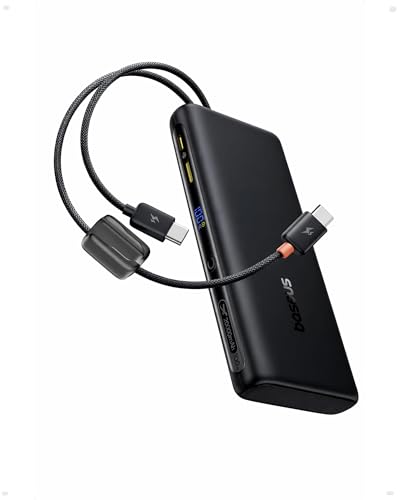
Baseus 100W 20000mAh Power Bank with USB-C Cables
Baseus’s 100W 20000mAh power bank with built-in USB-C cables is best for you in case you want one charger that can handle a phone, tablet, or even a laptop without adding extra cords to your bag. You get 100W PD fast charging, so your iPhone 17 Pro can reach 68% in 30 minutes, and a MacBook Air can hit 50%. The dual-braided cables double as a carrying strap, and four ports plus pass-through charging give you flexibility. Its smart display, slim 6 x 3 x 1-inch build, and 24-month warranty make travel easier.
- Capacity:20000mAh
- Fast Charging:100W
- USB-C:Built-in dual USB-C cables + USB-C ports
- Multi-Device Charging:4 ports
- Portable Design:Slim
- Safety:AI cooling
- Additional Feature:Dual-braided cables
- Additional Feature:Smart digital display
- Additional Feature:Graphene cooling technology
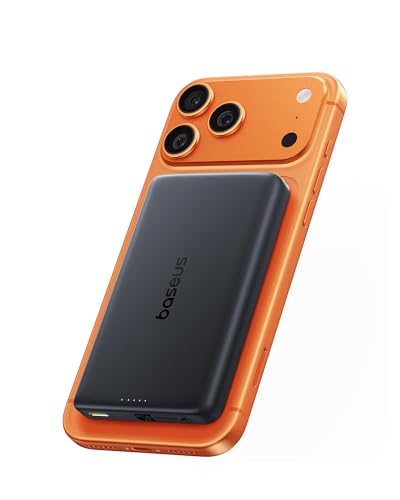
Baseus Picogo MagSafe 25W 10000mAh Power Bank
Should you want a MagSafe power bank that pairs fast wireless charging with real wired speed, the Baseus Picogo MagSafe 25W 10000mAh Power Bank is a strong pick for iPhone users who charge on the move. You get official Qi2.2 support, up to 25W magnetic charging, and up to 15W on iPhone 12–15 models. Plug in over USB-C for 45W output, and you can top up an iPhone 17 Pro Max from 0–65% in 30 minutes. Its 10,000mAh, TSA-compliant battery recharges in 1.5 hours and stays cool with smart temperature control.
- Capacity:10000mAh
- Fast Charging:25W wireless, 45W wired
- USB-C:USB-C wired charging
- Multi-Device Charging:Single device wireless or wired
- Portable Design:Compact magnetic
- Safety:NTC temperature control
- Additional Feature:Official Qi2.2 certification
- Additional Feature:Ultra-precise magnetic alignment
- Additional Feature:Aluminum alloy shell
Factors to Consider When Choosing Baseus Power Banks
When choosing a Baseus power bank, charging speed and battery capacity are usually the initial factors to compare. Port selection and cable convenience also matter, since they affect how easily multiple devices can be powered at once. Device compatibility should be checked to confirm the power bank matches the phones, tablets, or accessories it is meant to support.
Charging Speed
Charging speed is a key factor in choosing a Baseus power bank, since higher wattage output generally delivers faster top-ups, with common fast-charging options ranging from 22.5W to 100W depending on the device and model. A useful comparison point is the 30-minute charge benchmark, where some fast chargers can raise a phone to roughly 50% to 68%. For laptops and tablets, USB-C Power Delivery and outputs of 45W, 60W, or 100W help maintain practical charging rates. Recharge speed matters as well, because a 30W or 60W input can refill the power bank far quicker than a lower input. Whereas multiple devices are connected, total output is often shared, so per-port speed might drop.
Battery Capacity
Battery capacity is the next key factor to weigh after charging speed, because it determines how much total energy a Baseus power bank can store and how many times it can recharge a device before needing a refill. Measured in mAh, it directly affects real-world endurance. A 10,000mAh model is often ideal for everyday carry, since it stays compact while still providing about one to two phone charges, depending on the handset. A 20,000mAh option suits longer trips and heavier use, with enough reserve for multiple phone top-ups and useful backup for tablets or even some laptops. Larger capacities do require more time to recharge, so the added runtime should justify the extra size and refill time. Usage patterns should guide the choice.
Port Selection
Port selection matters because the right mix of connections determines how well a Baseus power bank fits a device setup. A model with USB-C supports modern fast charging, while USB-A remains useful for older accessories and mixed-device households. For users who charge several items at once, multiple output ports become essential; some Baseus units can power three or four devices simultaneously. A bidirectional USB-C port adds flexibility by handling both charging the power bank and discharging it to other devices. Higher port counts are especially practical for travel, work, or group use, whenever phones, tablets, and earbuds might all need power together. Built-in cables can further streamline the entire setup.
Cable Convenience
Beyond port count, cable convenience can shape how practical a Baseus power bank feels day to day. Built-in cables reduce the need to pack extras, which is useful for commuting, short trips, and unexpected outages. Integrated USB-C leads could also serve as carry straps or loops, improving portability without adding bulk. Cable durability matters as well; braided or reinforced designs are better suited to repeated bending and pulling, with higher bend or pull ratings often indicating longer service life. Models with multiple built-in cables, or a built-in cable paired with extra ports, can support charging more than one device at once. Cable storage also counts, since tidy stowage helps prevent tangles and keeps the power bank compact in a bag or pocket.
Device Compatibility
Device compatibility is one of the most significant factors as choosing a Baseus power bank. The output type should match the device’s charging port, whether that means USB-C, USB-A, a built-in USB-C cable, or wireless magnetic charging. It is also crucial to confirm support for the correct charging standard, such as PD 3.0, QC 3.0, or Qi2.2, because protocol compatibility affects fast-charging performance. Wattage matters as well: phones often charge efficiently at 22.5W to 45W, while laptops and some tablets might need up to 100W. Capacity should fit the device category, with 10,000mAh suited to phones and smaller tablets, and 20,000mAh better for tablets and laptops. For multiple devices, enough ports and mixed charging modes are essential.
Portability And Size
After compatibility is sorted, portability and size become the next practical filter for choosing a Baseus power bank. Smaller, slimmer models are easier to slip into a pocket, purse, backpack, or laptop bag, which matters for commuting, travel, and everyday carry. A 10,000mAh unit usually keeps the profile more compact, while 20,000mAh options deliver more charging capacity but add noticeable bulk and weight. Ultra-thin designs, sometimes under 0.8 inches thick, suit flights, meetings, and tight bag spaces. Weight also affects convenience: around 12.8 oz feels easier to carry than roughly 451 g. Compact footprints, such as 4.3 × 2.6 × 1.2 inches or 5.27 × 5.27 × 0.78 inches, help determine whether the bank fits travel kits comfortably.
Safety Certifications
Safety certifications should be a top check upon comparing Baseus power banks, since labels such as UL, FCC, TÜV, IEC, RoHS, DOE, CEC, or UN standards indicate that the unit has been assessed for electrical safety and compliance. Beyond the label, a dependable model should include safeguards against overcharge, overheat, short-circuit, overvoltage, overcurrent, and over-discharge. These protections help limit damage and reduce failure risk during daily use and travel. Temperature-control functions, including smart thermal monitoring or cooling systems, are also beneficial because they keep heat in check during faster charging. Certification-backed units usually reflect energy-efficiency and environmental requirements, not only battery safety rules. Clear certification claims, manuals, and support documents make it easier to confirm that the cells and circuitry have been inspected properly.
Wireless Charging Options
When comparing Baseus power banks with wireless charging, the key question is how much speed and stability the model can deliver without a cable. Certified magnetic wireless models can reach up to 25W, while older Qi-compatible phones might be limited to 15W. For quicker top-ups, it is better to choose a unit that specifically advertises high-speed magnetic wireless charging instead of basic wireless output. Magnetic alignment also matters: a strong magnet array helps keep the phone centered, reduces energy loss, and supports steadier charging. Thermal control is equally significant, because smart temperature management and cooling materials help keep the surface near 97°F (36.2°C). Wireless charging works best with compatible phones and cases; non-compatible devices still require wired USB-C charging.
Frequently Asked Questions
How Long Do Baseus Power Banks Usually Take to Recharge?
Baseus power banks often need 2 to 6 hours to recharge, depending on battery size and charger output. Bigger models take more time, while USB-C PD fast chargers can cut charging time for units that support them.
Are Baseus Power Banks Allowed on Airplanes?
Yes, usually, but only in carry on luggage and within airline watt hour limits. At screening, oversized or unmarked batteries may be refused. Travelers should check the specific airline rules and pack them accordingly.
Can Baseus Power Banks Charge Two Devices Simultaneously?
Yes, many Baseus power banks can charge two devices at the same time if they include more than one output port or support both wireless and wired charging. Charging speed and power distribution depend on the specific model, so it is worth checking the output details first.
Do Baseus Power Banks Support Passthrough Charging?
Yes, certain Baseus power banks support passthrough charging, so the bank can charge while powering a device at the same time. Support depends on the model, so check the product specifications carefully.
How Should I Safely Store a Baseus Power Bank for Travel?
Store the Baseus power bank at roughly 40 to 60 percent charge in a cool, dry place, ideally inside a protective case and away from metal items. Before you travel, inspect it for any damage and top it up if the charge is low.
Conclusion
In general, Baseus offers travel-friendly power banks that fit different needs without adding bulk. The 10,000mAh models suit light, daily carry, while the 20,000mAh options deliver the extra speed and capacity needed for laptops and longer trips. Even though some buyers worry about size or price, the mix of compact design, fast charging, and built-in safety features makes these picks practical, dependable choices for 2026 travelers.
