

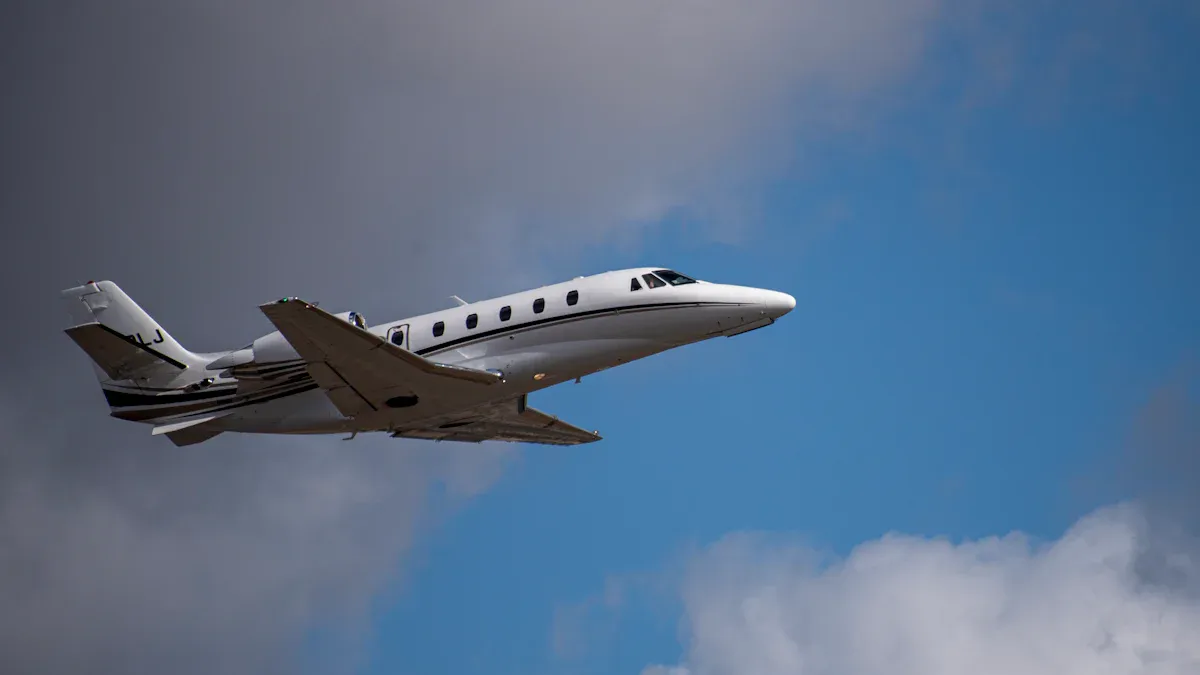
Affordable private jet ownership is indeed possible. You can balance lower acquisition costs with manageable operating expenses. This guide explores 15 specific small private jets. They make private air travel accessible. You get a gateway to personal aviation without prohibitive costs. These are the best small planes for your budget, offering practical private flight solutions.
Key Takeaways
Affordable private jet ownership is possible. It balances the jet’s buying price with its running costs.
Very Light Jets (VLJs) and light jets are good entry-level choices. They cost less to buy and run.
Buying a used jet can save you money. Used jets often have lower prices than new ones.
Consider all costs when buying a jet. These include fuel, upkeep, pilot training, and storage.
Other ways to fly private exist. These include fractional ownership, jet cards, and chartering services.
Understanding Affordable Private Jet Ownership
Defining Affordability: Acquisition vs. Operating Costs
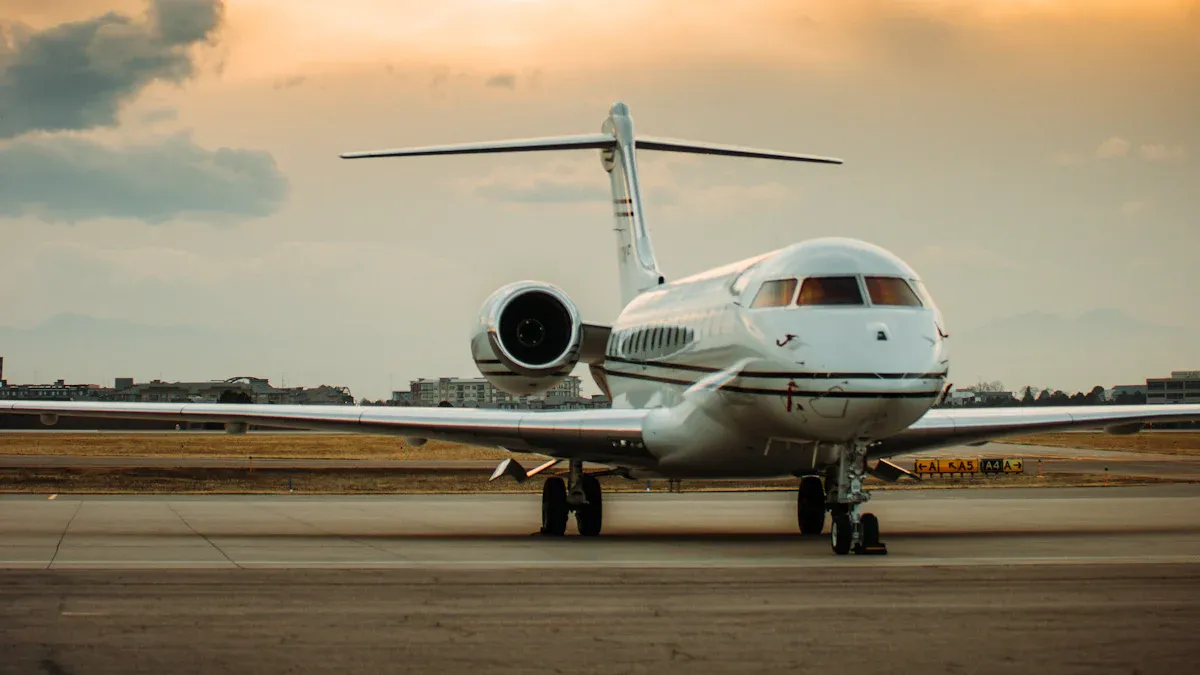
When you consider owning a private jet, you must look beyond the initial purchase price. Affordability involves two main costs: acquisition and operating expenses. The acquisition cost is what you pay to buy the jet. Operating costs are the ongoing expenses to fly and maintain it. These include fuel, maintenance, crew salaries, and hangar fees.
You can see the difference in these costs below:
Aircraft Class | Purchase Cost | Annual Operating Cost (200 Hrs/Year) |
|---|---|---|
Turboprop | $6.6 million | $700,000 |
VLJ | $4 million | $1 million |
Light Jet | $9 million | $1.2 million |
Very Light Jets (VLJs) and light jets are entry-level options. They typically cost between $3 million to $6 million to buy. Their annual operating expenses range from $1 million to $2 million. For example, the Eclipse 550 has low annual operating costs at $520,000. The Cirrus Vision SF50 G2 is also efficient, costing $534,000 annually.
Key Factors Influencing Jet Affordability
Several factors influence how affordable a private jet truly is. You need to consider the jet’s size and capacity. Smaller jets are less expensive than larger ones. The age of the jet also matters. Newer jets often cost more but have modern technology. Older jets might require more maintenance. Features and luxuries, like premium interiors or Wi-Fi, increase the price. Fuel efficiency is important; more efficient jets save you money over time. The flight range and the brand of the jet also affect its cost. To find the most affordable private jets, you must weigh all these points.
New vs. Used Market Insights
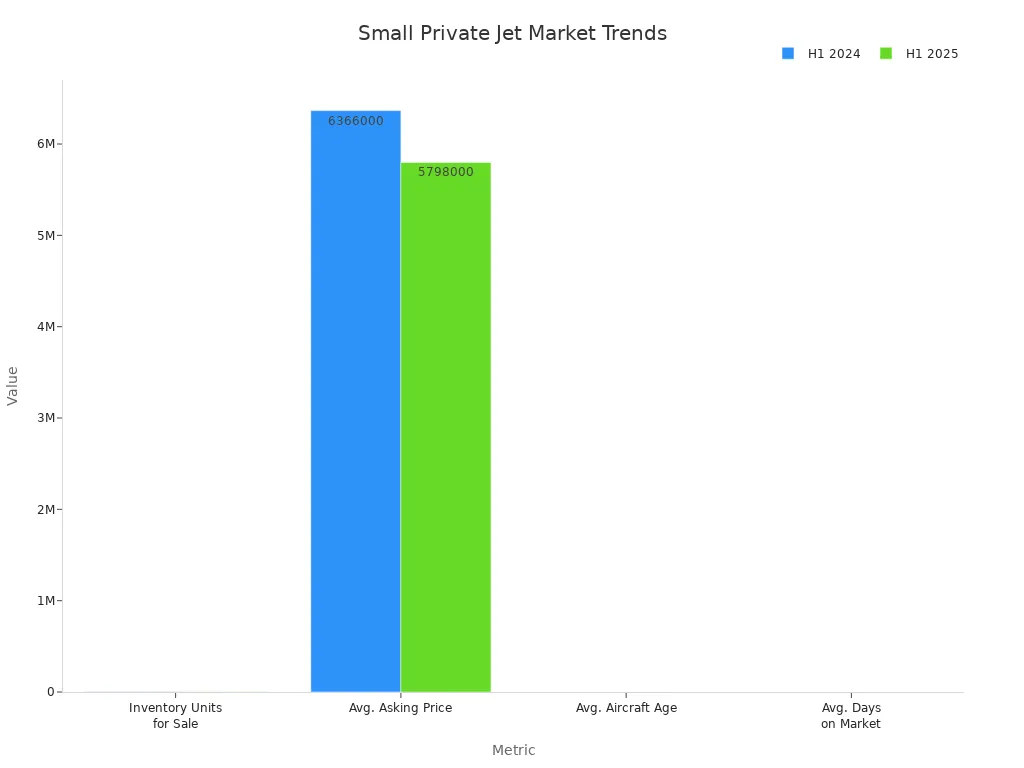
The market for new private jets remains strong. Demand for new light jets is high, with average prices expected to reach $27.29 million in 2025. However, supply chain issues limit growth. Light jets make up over 36% of all private jets globally.
For used small private jets, you have more choices. Inventory for midsize jets increased by 15% in 2025. Overall, the inventory of pre-owned business jets rose slightly by 2.7% in the first half of 2025 compared to 2024. Average asking prices for used jets dropped by 8.9% to $5.798 million in the first half of 2025. Older used aircraft are seeing further price corrections. Newer, well-equipped used models hold their value better.
The average age of listed used aircraft is increasing, leading to longer sales cycles. This means they stay on the market longer. Pricing is stabilizing, and high-quality, low-time used jets still command premium prices. This makes the used market a great place to find the most affordable private jets.
Top 15 Best Small Planes: Affordable Private Jets
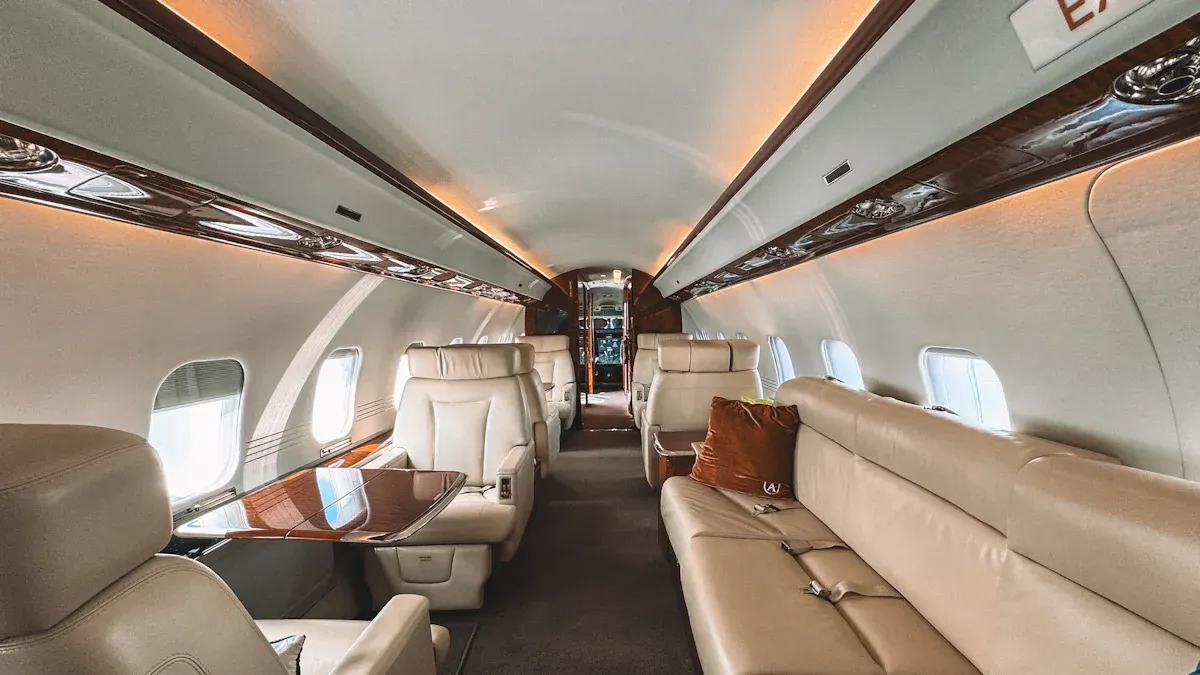
You can find many excellent options when you look for the best small planes that offer private travel without breaking your budget. These aircraft balance initial cost with ongoing operational expenses. Here, you will explore 15 specific models that make private jet ownership more accessible.
Citation Mustang
The Citation Mustang is a Very Light Jet (VLJ) that serves as an excellent entry point into private jet ownership. It offers a blend of performance and economy.
Key Features and Capacity: This jet features a Garmin G1000 avionics suite, which includes digital engine controls and a Garmin autopilot. You get big-iron-style operational features like an engine fire extinguishing system, anti-skid braking, and certification for flight in known icing conditions. The Mustang has two Pratt & Whitney Canada PW615F engines, each providing nearly 1,500 lbs of thrust. It reaches a max cruise speed of 340 knots. The cabin typically seats four passengers, with two crew in the cockpit. It is certified for single-pilot operation. You also get executive seating with fold-out tables and a total baggage capacity of 57 cubic feet.
Estimated Price Range: Used Mustangs currently sell for $1.5 million to $2 million. New, they cost around $3.3 million. Today, you can find a Cessna Citation Mustang 510 for about $1,750,000.
Operating Costs: Operating costs run about $1,000 per hour. The variable operating cost is around $1,500 per hour, with an average fuel burn of 95 gallons per hour. Your estimated annual budget for operating a Citation Mustang is $858,656, based on 325 hours of flight time per year. Fuel costs are approximately $412 per hour. Maintenance generally ranges from $60-$110 per hour.
Why it’s Affordable: The Citation Mustang is a popular entry-level jet. It combines luxury with practicality and lower operating costs, making it one of the most affordable private jets in its class.
Eclipse 500/550
The Eclipse 500 and its successor, the 550, are twin-engine Very Light Jets known for their exceptional fuel efficiency.
Key Features and Capacity: The Eclipse 550 uses two P&WC 610F engines, each producing 900 lbs of thrust. This allows a maximum cruise speed of 375 ktas (430 mph). It is the most fuel-efficient twin-engine jet. You can fly at 41,000 feet, above most adverse weather. The Eclipse 500 features an advanced Avio NG avionics suite, which reduces pilot workload and enhances safety. The aircraft typically seats four passengers, with a maximum seating for five. It is designed for missions under 750 nautical miles, ideal for three or fewer passengers.
Estimated Price Range: A new Eclipse 550 costs $2.995 million. The Eclipse 500 Special Edition costs $2.195 million. You can find used models for around $850,000.
Operating Costs: The typical operating cost for an Eclipse 500/550 is approximately $888 per hour, reflecting its design emphasis on minimal fuel consumption and cost-effective operation. It consumes only 48-59 gallons of fuel per hour during cruise flight. Maintenance is economical due to the simplified design of its Pratt & Whitney PW610F turbofan engines.
Why it’s Affordable: The Eclipse 550 is the only twin-engine jet under $3 million. It is also the least expensive twin-engine jet to own and operate, thanks to its small and efficient design and minimal fuel consumption.
HondaJet HA-420
The HondaJet HA-420 stands out with its unique Over-The-Wing Engine Mount (OTWEM) design, which provides a quieter cabin and more interior space.
Key Features and Capacity: This innovative jet offers a spacious cabin for its class. It typically seats four to five passengers, plus one or two pilots. The OTWEM design reduces drag and improves fuel efficiency. You get advanced Garmin G3000 avionics.
Estimated Price Range: New HondaJets typically range from $5 million to $6 million. Used models can be found for less, depending on age and condition.
Operating Costs: The HondaJet has a fuel consumption of 121 US gallons per hour. For a 600 nautical mile trip, the fuel burn is about 1,185 pounds per hour. The cost per gallon is around $5.47. While a detailed annual budget is not readily available, its design aims for competitive operating costs within the light jet category.
Why it’s Affordable: The HondaJet offers a modern, comfortable, and efficient private jet experience. Its innovative design contributes to lower operating costs compared to many other light jets, making it an attractive option for those seeking a contemporary and affordable private jet.
Embraer Phenom 100/300
Embraer’s Phenom series offers a range of light jets, from the entry-level Phenom 100 to the more capable Phenom 300.
Phenom 100:
Key Features and Capacity: This jet has a top speed of Mach 0.70 and a max range of 1,178 nautical miles with four occupants. It flies at a service ceiling of 41,000 feet. It uses two Pratt & Whitney Canada PW617F-E engines. The Prodigy Flight Deck 100 (Garmin G1000 based) provides advanced avionics. The interior features adjustable leather seats, ample legroom, large windows, and a private rear lavatory. It typically seats four passengers but can accommodate up to seven with a single pilot.
Estimated Price Range: Hourly rental rates are around $2,700 USD per hour.
Phenom 300:
Key Features and Capacity: The Phenom 300 boasts a top speed of Mach 0.78 and a max range of 1,971 nautical miles. It reaches a service ceiling of 45,000 feet. It is powered by two Pratt & Whitney Canada PW535E engines. The Prodigy Flight Deck 300 (Garmin G1000 based) offers advanced controls. You get reclining seats, a private lavatory, and ample luggage room. It typically seats six passengers and can accommodate up to ten in a high-density configuration.
Estimated Price Range: New, the Phenom 300 costs approximately $9.5 million. Used models are around $8 million USD. Hourly rates start from $3,000 USD.
Operating Costs (Phenom 300): For 450 annual owner-operated hours, the total variable costs are $1,124,060, and total fixed costs are $633,527. This results in an annual budget of $1,757,587, or $3,906 per hour.
Why it’s Affordable: The Phenom 100 is a strong contender for an entry-level light jet, offering good performance and comfort for its price. The Phenom 300, while more expensive, provides greater range and capacity with competitive operating costs for a light jet, making it a valuable option in the used market for those seeking more capability.
Cessna Citation M2
The Cessna Citation M2 is a modern light jet that combines performance with advanced technology, making it a popular choice for owner-pilots and small businesses.
Key Features and Capacity: This jet features a three-screen Garmin G3000 avionics suite, digital color weather radar, and safety systems like TCAS and TAWS. It is powered by two Williams FJ-44-1AP-21 engines, each providing 1,965 lbs of thrust. You can reach a maximum speed of 404 ktas and a range of 1,550 nautical miles with four occupants. The M2 has a service ceiling of 41,000 feet. It accommodates a pilot plus six to seven passengers, offering luxurious seating, charging ports, and accent lighting.
Estimated Price Range: The base price for a Citation M2 is around $4.5 million. A new M2 Gen 2 can cost $6.15 million.
Operating Costs: The variable operating cost for a Citation M2 is $1,800 per hour, with an average fuel burn of 120 gallons per hour. Your estimated annual budget for operating this jet is $990,619, based on 325 hours of flight time per year. For 200 hours per year, the total hourly cost is $3,728.
Why it’s Affordable: The Citation M2 offers a modern flight deck and comfortable cabin in the light jet category. Its operating costs are competitive for a new-generation jet, providing a good balance of features and affordability for private ownership.
Pilatus PC-24
The Pilatus PC-24 is known as the “Super Versatile Jet” due to its ability to operate from short, unpaved runways, a unique feature for a business jet.
Key Features and Capacity: This twin-engine turbofan aircraft has a standard private jet design but with long-stroke trailing link landing gear, allowing it to land on uneven surfaces. It features a large cargo door, which can fit a standard pallet. Powered by two Williams FJ44 turbofan engines, each providing 3,400 pounds of thrust, it offers excellent performance. The Honeywell Primus Epic 2 avionics suite allows for single-pilot operation. The PC-24 can accommodate up to 11 passengers plus one pilot, or a maximum of ten passengers in a typical configuration.
Estimated Price Range: New Pilatus PC-24 aircraft are typically priced around $13 million. A 2025 model year PC-24 has an estimated price of $11,478,997. Older PC-24s can be found for significantly less.
Operating Costs:
Variable Costs (per hour): Fuel costs you around $1,199, maintenance $528, engine reserves $359, and miscellaneous expenses $169.
Fixed Costs (annually): Crew salaries are about $390,390, hangar fees $50,600, insurance $53,521, and miscellaneous expenses $6,300.
Your total annual budget could be $911,480 for 200 hours per year, or $1,539,460 for 400 hours per year.
Why it’s Affordable: While its acquisition cost is higher than some VLJs, the PC-24’s unique versatility, including short-field capability and single-pilot certification, can lead to significant operational savings. This makes it a cost-effective choice for specific mission profiles, offering a robust private jet experience.
Cirrus Vision Jet SF50
The Cirrus Vision Jet SF50 is a single-engine Very Light Jet, notable for its inclusion of the Cirrus Airframe Parachute System (CAPS).
Key Features and Capacity: This jet is powered by a single Williams FJ-33-5A turbofan engine. It features a Garmin G1000 avionics suite. The CAPS parachute system provides an extra layer of safety. The aircraft is designed for a one-person crew and can carry up to three passengers, though it is a seven-seat jet.
Estimated Price Range: The acquisition cost for a Cirrus Vision Jet SF50 is approximately $2,358,764.
Operating Costs: The Vision Jet has a fuel burn of 50 gallons per hour. Its direct operating cost is as low as $700 per flight hour, including fuel, oil, and hourly maintenance. Annual fixed costs are estimated at $179,657, leading to total annual costs of $326,257 for 200 hours per year. The total cost of ownership can be around $490,117.90, with a cost per hour of $859.27.
Why it’s Affordable: The Cirrus Vision Jet SF50 is one of the most affordable private jets to acquire and operate. Its single-engine configuration and small and efficient design contribute to significantly lower fuel and maintenance costs, making private jet travel more accessible.
Beechcraft Premier I/IA
The Beechcraft Premier I and its upgraded version, the Premier IA, are light jets known for their composite fuselage and a surprisingly spacious stand-up cabin for their class.
Key Features and Capacity: These jets are powered by two Williams FJ44-2A turbofan engines. They offer a maximum cruise speed of 451 knots and a range of 1,430 nautical miles. The service ceiling is 41,000 feet. You get Collins Pro Line 21 avionics. The cabin typically seats six to seven passengers, with an enclosed aft lavatory and a small forward galley. It also provides 77 cubic feet of baggage capacity.
Estimated Price Range: Used Premier I/IA models typically range between $1.5 million and $3 million, depending on their year, condition, and upgrades.
Operating Costs: The direct operating cost is approximately $1,500 – $2,000 per hour, with an hourly fuel burn of 150-180 gallons. Your total annual operating cost could be $1,272,121 for 200 hours per year, or $1,827,571 for 350 hours per year. Fixed costs are around $531,521 annually.
Why it’s Affordable: The Premier I/IA offers excellent speed and a comfortable stand-up cabin at a competitive used price. Its operating costs are relatively low compared to larger jets, providing a good private jet experience.
Learjet 31/35/45
The Learjet series, including the 31, 35, and 45 models, are iconic business jets renowned for their speed and performance.
Key Features and Capacity: These jets are known for their sleek design and ability to fly at high speeds. They typically seat six to eight passengers, depending on the specific model and cabin configuration. You get a comfortable cabin for business travel.
Estimated Price Range: Older Learjet 31 and 35 models can be acquired for under $1 million on the used market. Learjet 45 models typically range from $2 million to $4 million.
Operating Costs: Maintenance is a key consideration for these aircraft. You will need hourly inspections (e.g., 50, 100, or 300 hours) for wear and tear. Phase inspections break down maintenance into manageable segments. Hot section inspections are essential for the turbine engines. Pre-purchase inspections are crucial to identify potential issues like corrosion or outdated avionics, which can lead to unexpected costs. Routine inspections help reduce operational costs by catching minor issues early.
Why it’s Affordable: Older Learjet models offer some of the fastest and most affordable jets on the used market. You get high performance at a significantly lower acquisition cost. However, you must budget for thorough maintenance to ensure reliability and manage ongoing expenses.
Hawker 400XP
The Hawker 400XP is a light business jet that evolved from the Mitsubishi Diamond. It is known for its spacious cabin and good speed.
Key Features and Capacity: This jet typically seats seven to eight passengers. It offers a comfortable cabin for its class. You get a range suitable for regional travel. It is powered by two Pratt & Whitney Canada JT15D-5R engines.
Estimated Price Range: Used Hawker 400XP models generally range from $1.5 million to $3 million, depending on age, condition, and avionics upgrades.
Operating Costs: Operating costs for the Hawker 400XP are competitive within the light jet category. You can expect fuel burn and maintenance costs similar to other jets of its size.
Why it’s Affordable: The Hawker 400XP provides a good balance of cabin comfort, speed, and range for its price point on the used market. It offers a solid private jet experience without the higher acquisition costs of newer models.
Dassault Falcon 10/20 (Older Models)
The Dassault Falcon 10 and 20 are older, larger business jets that you can now find at very attractive acquisition prices.
Key Features and Capacity: These are mid-size to large cabin jets. The Falcon 10 typically seats four to seven passengers, while the Falcon 20 can accommodate eight to ten. They are known for their robust construction and good performance for their era.
Estimated Price Range: You can often find older Falcon 10 and 20 models for under $1 million, sometimes even for a few hundred thousand dollars, making them incredibly low-cost for initial purchase.
Operating Costs: While the acquisition cost is low, you should expect higher operating costs. These older jets are less fuel-efficient than modern aircraft. Maintenance can also be more expensive due to the age of components and potentially harder-to-find parts.
Why it’s Affordable: The extremely low acquisition cost makes these some of the most affordable private jets to buy. However, you must be prepared for higher ongoing operational expenses. This option is best for those who prioritize initial savings and understand the commitment to maintaining an older, larger private jet.
Bombardier Challenger 300 (Used Market)
The Bombardier Challenger 300 is a super mid-size jet known for its excellent range, speed, and comfortable cabin.
Key Features and Capacity: This jet typically seats eight to ten passengers. It offers a stand-up cabin and a range of over 3,000 nautical miles, allowing for transcontinental flights. You get a smooth ride and advanced avionics.
Estimated Price Range: On the used market, Challenger 300 models typically range from $8 million to $15 million, depending on the year of manufacture, total time, and condition.
Operating Costs: Operating costs for a super mid-size jet are higher than for light jets. You can expect competitive fuel efficiency for its class and robust maintenance programs.
Why it’s Affordable: While not as inexpensive as VLJs, the Challenger 300 on the used market offers a significant step up in range and comfort compared to light jets. You get a highly capable super mid-size private jet at a much lower price than a new equivalent, making it an affordable option in its category.
Gulfstream G100/G150 (Used Market)
The Gulfstream G100 and G150 are mid-size jets that offer impressive performance and the renowned Gulfstream brand experience.
Key Features and Capacity: These jets typically seat six to eight passengers. They are known for their speed, range, and comfortable cabins. The G150, an upgraded version of the G100, offers improved performance and a wider cabin. You get advanced avionics and a reliable private jet.
Estimated Price Range: On the used market, Gulfstream G100 models can range from $2 million to $4 million. G150 models typically sell for $5 million to $9 million.
Operating Costs: Operating costs for these mid-size jets are higher than for light jets but competitive for their class. You can expect good fuel efficiency and reliable performance.
Why it’s Affordable: Acquiring a used Gulfstream G100 or G150 allows you to own a high-performance mid-size private jet at a fraction of the cost of a new one. You gain access to the Gulfstream reputation for quality and capability, making it an affordable choice for those needing more range and space than a light jet.
Sino Swearingen SJ30
The Sino Swearingen SJ30, also known as the Emivest Aerospace SJ30, is a light business jet recognized for its high-altitude performance and speed.
Key Features and Capacity: This jet is designed to fly at high altitudes (up to 49,000 feet) and high speeds (up to Mach 0.83). It typically seats five to six passengers. You get a comfortable cabin with a unique “sea-level” cabin pressure at 41,000 feet, which reduces passenger fatigue.
Estimated Price Range: Used SJ30 models can be found for $2 million to $4 million, though they are relatively rare on the market.
Operating Costs: The SJ30’s high-altitude performance contributes to fuel efficiency. Operating costs are competitive for a light jet, but maintenance can be a consideration due to its unique design and limited production numbers.
Why it’s Affordable: The SJ30 offers exceptional performance for a light jet, including high speed and altitude, at a competitive used price. Its unique features provide a premium private travel experience, making it an affordable option for those who value performance.
Diamond D-JET (Niche/Historical Context)
The Diamond D-JET is a single-engine Very Light Jet that holds a niche and historical place in the world of private aviation.
Key Features and Capacity: This jet was designed as a personal jet, featuring a single turbofan engine and a spacious cabin for its size. It aimed to seat five people (one pilot, four passengers). It featured advanced Garmin G1000 avionics.
Estimated Price Range: The Diamond D-JET never reached full commercial production. Therefore, you cannot typically purchase a new one, and used models are extremely rare, if available at all.
Operating Costs: Operational costs were projected to be low due to its single-engine design and VLJ classification. However, these are theoretical as the aircraft did not enter widespread service.
Why it’s Affordable: While not a practical purchase today, the D-JET represents an attempt to create a highly affordable private jet. It is included for its historical context in the pursuit of making private jet ownership more accessible.
Key Considerations for Affordable Private Jet Ownership
Maintenance and Parts Availability
You must consider maintenance and parts availability. These factors greatly impact your ownership costs. Older aircraft might have harder-to-find parts. This can increase repair times and expenses. Research your specific aircraft model.
Pilot Requirements and Training
Operating a private jet requires specific pilot certifications. You need to meet flight hour requirements.
Private Pilot License (PPL): Requires at least 40 hours of flying.
Instrument Rating (IR): Allows flight in various weather. Needs 40 more flight hours.
Commercial Pilot License (CPL): Enables paid flight. Needs at least 250 hours of flying.
Multi-Engine Rating: Essential for jets. Needs 5-10 hours in a multi-engine aircraft.
Jet Type Rating: Specific to the jet you fly. Involves intensive training.
Airline Transport Pilot License (ATPL): Highest license. Qualifies pilots to command large aircraft. Total training costs for a licensed pilot typically range from $70,000 to $100,000.
Insurance Costs
Insurance is a significant cost for your aircraft. Premiums vary based on several factors. Aircraft insurance typically ranges from 1% to 3% of the aircraft’s value annually. For instance, a $20 million plane could cost $200,000 to $600,000 per year. Your intended use also affects the premium:
Personal / Pleasure: Lowest premiums.
Business / Corporate: Moderate premiums.
Charter / Commercial: Highest premiums.
Here are examples for specific aircraft types:
Aircraft Type | Hull Value | Annual Premium Range |
|---|---|---|
Citation CJ | $5M | $10,000–$25,000 |
Jet (general) | N/A | 0.4%–0.8% of hull value |
Hangarage and Storage Solutions
You need a place to store your aircraft. Hangarage costs vary by location and size.
Jet Size | Annual Hangar Cost |
|---|---|
Smaller Jets | $36,000 |
Larger Jets | $96,000 |
Consider these costs when budgeting for your affordable private jet. |
Resale Value and Market Trends
Depreciation greatly impacts an aircraft’s resale value. Market demand and new technology can cause some models to lose value faster. You should research models with better value retention. Monitor sales data and reports. This helps you make informed decisions.
The 100% depreciation incentive for aircraft purchases ended on December 31, 2022. This incentive will decrease to 80% in 2023. It will go down to 60% in 2024. This change will influence resale value trends for aircraft.
Models that hold their value well are popular. High depreciation can reduce the benefits of a lower initial price.
Alternative Private Jet Ownership Models
Fractional Ownership
You do not have to buy an entire aircraft. Fractional ownership lets you buy a share of a jet. This reduces your initial investment. You share ongoing expenses like maintenance, upkeep, fuel, and operational costs. This makes them more manageable. You only pay for the time you use the aircraft.
This avoids charges for return trips to a home base. Business owners can also deduct a portion of costs for work-related travel.
However, the upfront cost for a share can still be substantial. A 1/16th share in a mid-size jet can range from $350,000 to $700,000. You also pay annual operational costs adding $100,000–$200,000. Aircraft lose value over time. This means the resale value you get is often less than your initial investment. Selling a fractional share can be challenging due to a limited market.
Jet Cards
Jet cards offer another way to fly private. You prepay for flight hours. This locks in hourly rates. You get guaranteed access to an aircraft. This model is good if you fly 25–75 hours per year. It offers predictable pricing and flexibility. There are no long-term commitments. This makes it more convenient and affordable for frequent flyers than chartering.
Model | Upfront Cost | Ongoing Cost | Ideal Usage (hours/year) |
|---|---|---|---|
Jet Card | $150K-$300K | None | 25-75 |
Full Ownership | $3M-$70M+ | Millions per year | 200+ |
Chartering Services
Chartering services let you book a private flight on demand. You pay for each trip. This is useful for occasional travel. You do not have any ownership responsibilities. You simply choose your aircraft and destination. This offers maximum flexibility without any long-term commitment or upfront investment.
You now understand that private jet ownership can be a reality. Careful research into acquisition and operating costs helps you find the best small planes. Consider maintenance, pilot training, and insurance. Consult aviation professionals and financial advisors before you buy. You can confidently explore private jet ownership. You will find the best small planes that fit your budget.