


Iconic buildings in the United Kingdom serve as vital links to the past. They preserve cultural heritage and enhance local identities. Recent studies show that revitalizing these structures strengthens community ties and fosters emotional connections. This blend of history and architecture makes these famous buildings noteworthy and essential to understanding British culture.
Key Takeaways
Iconic buildings in the UK, like the Tower of London and Westminster Abbey, connect people to their history and cultural heritage.
Visiting historical sites enhances your understanding of British culture and supports local economies through tourism.
Landmarks such as the Angel of the North and The Kelpies not only celebrate heritage but also boost community pride and local development.
Tower of London

Historical Background
The Tower of London stands as a symbol of British history. You can trace its origins back to 1078 when William the Conqueror began constructing the White Tower. Over the centuries, this fortress has witnessed significant events. Here are some key moments in its history:
1100: The first prisoner, Ranulf Flambard, escapes.
1140: The Tower is first used as a royal residence.
1381: The Tower is stormed during the Peasant’s Revolt.
1536: Anne Boleyn is beheaded on Tower Green.
1952: The Krays are held in the Tower for four days.
As a UNESCO World Heritage Site, the Tower of London attracts over 2.7 million visitors each year. This impressive number highlights its cultural significance as a historic site, showcasing its role as a royal palace, fortress, and prison.
Architectural Features
The Tower of London showcases a blend of architectural styles. Initially built in the Norman style, it reflects the power of William the Conqueror after the Norman invasion. Significant changes occurred under William II, marking the castle’s evolution into a fortified structure.
In 1851, Queen Victoria’s re-medievalization efforts restored several towers to reflect medieval architecture. This shift indicated a growing interest in tourism and public engagement. The Tower’s design features include imposing stone walls, a moat, and several towers, each with its unique history and purpose.
You can appreciate how the Tower of London not only serves as a historical monument but also as a testament to the evolution of British architecture.
Iconic Landmarks: Big Ben and Westminster Abbey
Big Ben
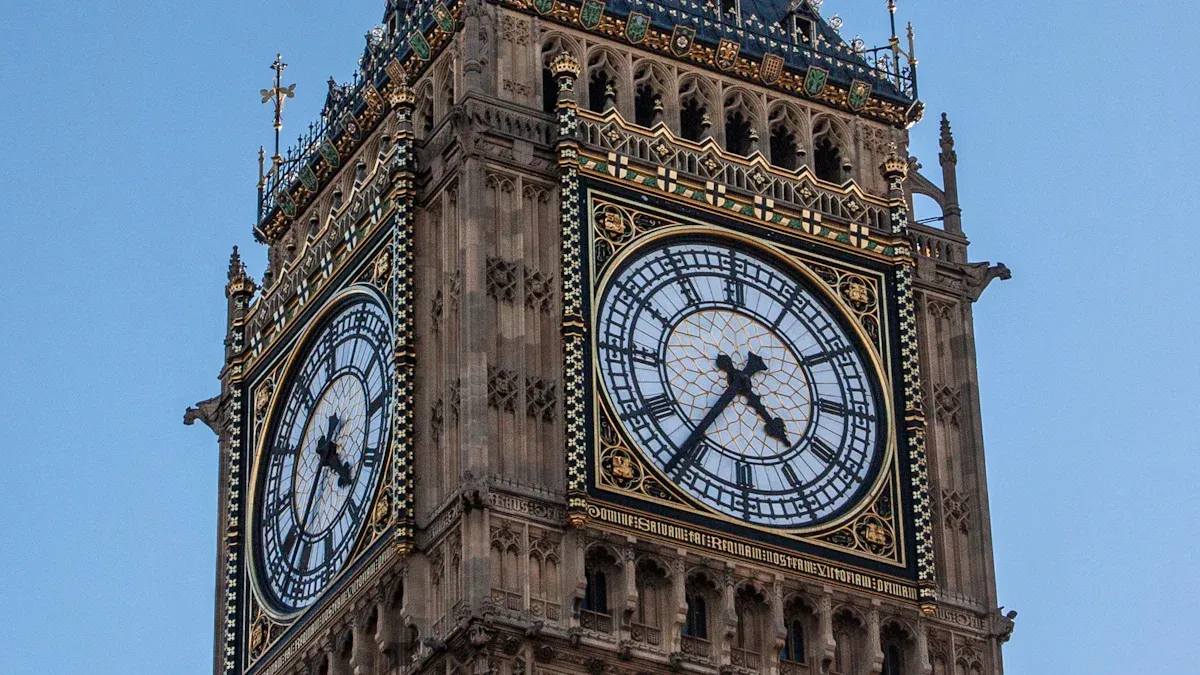
Big Ben, officially known as the Elizabeth Tower, stands tall at the north end of the Palace of Westminster. This landmark has become a powerful symbol of British national identity. It represents political stability and resilience. You can see its significance during major national events, where it often broadcasts the time, creating a deep emotional connection with the public.
Big Ben serves as a powerful symbol of British national identity, representing political stability, resilience, and the historical narrative of the nation.
The architecture of Big Ben has influenced clock tower designs worldwide. Its Gothic Revival style features:
A square base that supports the tower’s height.
Decorative symbols that enhance its visual appeal.
A design that has inspired similar structures in various countries.
Westminster Abbey
Westminster Abbey holds a special place in British history. It has been the site of significant royal events, including coronations, royal weddings, and state funerals. This landmark affirms the continuity and identity of the British monarchy.
The coronation ceremony has remained largely unchanged for 900 years. It includes the monarch being anointed and crowned in the Abbey. Queen Elizabeth II’s coronation in 1953 exemplifies this tradition.
The Abbey hosted the State Funeral of Queen Elizabeth II in 2022, marking a historic moment as it was the first sovereign funeral there since 1760.
It serves as a final resting place for many monarchs, highlighting its role in the national memory.
King Charles III will be the 40th monarch crowned at Westminster Abbey, reinforcing its historical importance.
Westminster Abbey is not just a site for crowning; it has adapted to represent the diversity of modern Britain. Leaders from multiple faiths have participated in recent ceremonies, showcasing the Abbey’s evolving role in society.
Famous Buildings: The British Museum and Abbotsford House
British Museum
The British Museum stands as a treasure trove of global history. Established in 1753, it houses millions of artifacts that reflect the diverse cultures of the world. You can explore notable pieces like the Rosetta Stone, which helped unlock the secrets of ancient Egyptian hieroglyphs. Other significant artifacts include:
Winged Lions of Nimrud: Colossal sculptures from the Neo-Assyrian empire.
Bronze Portrait of the Emperor Augustus: A representation of Roman history.
Sutton Hoo Helmet: An important artifact from Anglo-Saxon England.
Mexican Serpent Mosaic: A piece highlighting Aztec culture.
The Parthenon Marbles: Classical Greek sculptures showcasing ancient art.
In 2024, the British Museum attracted 6.5 million visitors, marking its highest attendance since 2015. This popularity underscores its global significance as one of the most visited museums in the world.
Abbotsford House
Abbotsford House, the former home of Sir Walter Scott, showcases a unique architectural style. It features the Scottish baronial style, which reflects Scotland’s rich heritage. The design incorporates decorative elements from various Scottish buildings, emphasizing national pride.
“The Abbotsford of Sir Walter Scott was, as much as Ivanhoe or Rob Roy, his own creation. Its architecture, the furniture he chose for it, and the life he aimed for within it, were the embodiment of the Scottish Romanticism which infused his poetry and novels.”
Abbotsford House is not just a historic home; it serves as a literary landmark. With Scott’s library of over 9,000 books, it attracts thousands of visitors each year, celebrating his contributions to literature and culture.
Historical Sites: Stonehenge and Durham Castle
Stonehenge
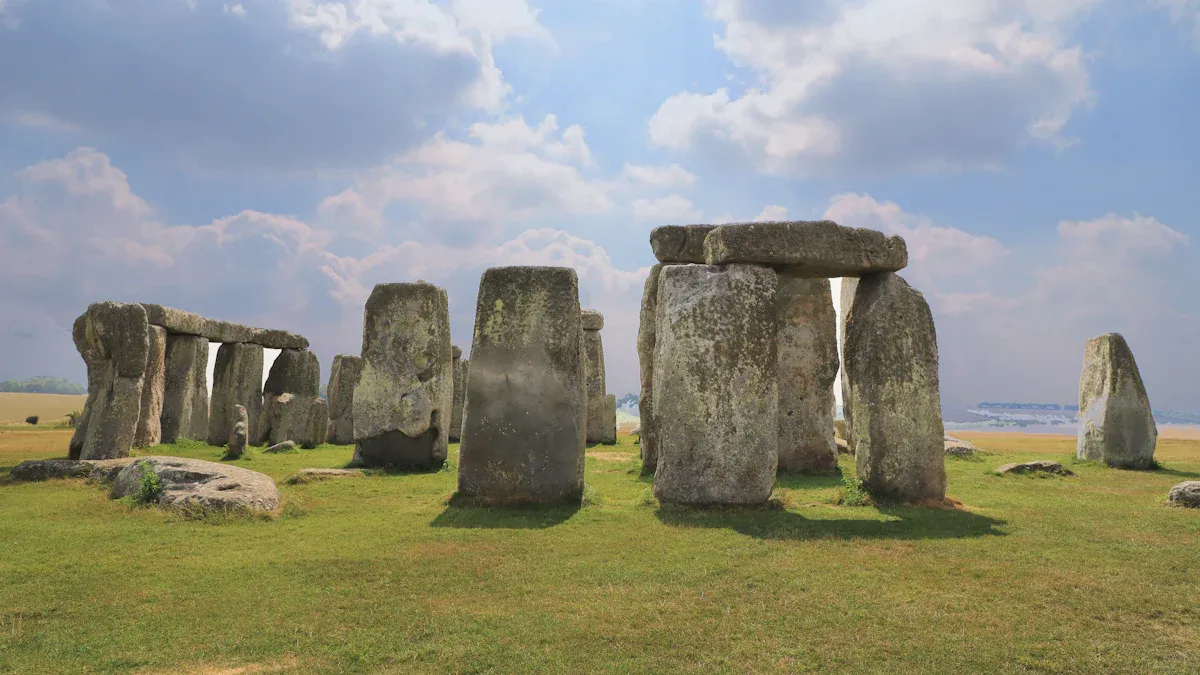
Stonehenge stands as one of the best-preserved prehistoric sites in the world. This iconic landmark dates back to around 3000 BC. You can explore its mysterious origins and significance through archaeological evidence. Excavations reveal human habitation around the Salisbury plains shortly after the last ice age. Wooden henge structures from approximately 8000 BC show early human activity.
The alignment of a natural geological gully with the sunrise and sunset during solstices indicates a sophisticated understanding of astronomy. This suggests that the site held spiritual and ceremonial importance. Additionally, the discovery of cremated human remains in the Aubrey Holes implies that Stonehenge may have served as a cemetery in its earliest form.
“Stonehenge is not just a collection of stones; it is a testament to the ingenuity and beliefs of our ancestors.”
Durham Castle
Durham Castle plays a crucial role in Norman history. Built shortly after the Norman Conquest in 1072, William the Conqueror ordered its construction to establish control in the North. The castle served as a seat of power for the prince-bishops, who had military authority and autonomy. This allowed them to defend against Scottish incursions and local rebellions.
The castle’s strategic importance is evident in its defense against the Harrying of the North. It protected the bishop and his household from attacks. Over time, Durham Castle’s function has evolved.
Original Function | Current Function |
|---|---|
Defensive stronghold | Site of education, worship, and community engagement |
Residence for the Prince Bishops | Used by Durham University for learning and scholarship |
Imposing structure to deter attackers | Venue for civic functions and ceremonies |
Religious establishment (Norman Chapel) | Ongoing place of worship |
Today, you can appreciate Durham Castle not only as a historic landmark but also as a vibrant part of the community.
Contemporary Landmarks: The Angel of the North and The Kelpies
Angel of the North
The Angel of the North stands as a remarkable piece of public art in Gateshead. This sculpture, designed by Antony Gormley, has become a symbol of the region. You can appreciate its cultural significance through its impressive size and unique design.
Aspect | Details |
|---|---|
Inspiration | The design was inspired by Antony Gormley’s earlier works, particularly The Case for an Angel. |
Initial Opposition | The project faced significant opposition from local politicians, with claims it would be ‘ugly’. |
Public Reception | Over time, the Angel has become an iconic symbol of Gateshead, recognized for its positive impact on local pride. |
Recognition | It is now listed as an ‘Icon of England’ and has been described as one of the most recognizable pieces of public art. |
Community Impact | A study suggested it improved the wellbeing and pride of Gateshead residents. |
Approximately 400,000 people visit the Angel of the North each year. This influx of visitors has helped attract around £145 million in lottery funding for local projects. The tourism and cultural industries have seen a boost in employment due to the Angel’s influence.
The Kelpies
The Kelpies, located in Falkirk, represent a blend of Scottish folklore and industrial heritage. These massive horse-head sculptures symbolize the shape-shifting aquatic spirit known for luring travelers. Their design incorporates elements of myth and the historical significance of Clydesdale horses.
The Kelpies have contributed significantly to the regeneration of the Falkirk area.
They have generated a Gross Value Added (GVA) of £81 million.
The project created 110 new full-time equivalent jobs and contributed £47 million in wages.
Local tourism has grown by 73%, with participation in cultural and community events reaching 300,000.
The Helix project surrounding the Kelpies includes the planting of over 750,000 trees and the development of nature parks and paths. You can see how these landmarks not only celebrate Scottish culture but also enhance the local economy and environment.
Iconic buildings in the United Kingdom significantly shape your understanding of British history. They connect you to the past and enhance your appreciation for cultural heritage. Visiting these sites fosters historical awareness, enriching your educational experience. Moreover, they contribute to the economy, supporting jobs and tourism.
“Heritage sites not only tell stories but also promote community well-being.”
FAQ
What is the significance of Hadrian’s Wall in Britain?
Hadrian’s Wall marked the northern boundary of the Roman Empire in Britain. It served as a defense and a symbol of Roman power.
How can I visit the Tower of London?
You can visit the Tower of London by purchasing tickets online. It’s best to book in advance to avoid long lines.
What are some famous landmarks in Britain?
Some famous landmarks in Britain include Big Ben, Westminster Abbey, and Stonehenge. Each site offers a unique glimpse into British history.
