



Global travel is more popular than ever. However, exploring remote, global regions often means you are out of cellular range. Satellite phones provide a critical, reliable communication solution in these areas. They ensure your safety, enable emergency communication, and maintain connectivity. This guide reviews 10 of the best satellite phones available for global adventurers. It helps you understand your options and choose the ideal device for your specific global travel needs.
Key Takeaways
Satellite phones use Earth-orbiting satellites. They work where cell phones do not. This helps you stay connected in remote places.
Choose a satellite phone based on coverage, battery life, and how tough it is. Also, think about the cost of the phone and its service plan.
Learn how to use your satellite phone’s SOS button. This button sends your location to help in an emergency. It can save your life.
Manage your phone’s battery. Keep it charged. Get a good signal. This makes the battery last longer.
Protect your satellite phone from bad weather. Many phones are built strong. They can handle tough conditions.
Understanding Satellite Phones for Global Travel

What is a Satellite Phone and How It Works
Satellite phones are mobile communication devices. They use Earth-orbiting satellites to send and receive data. Unlike regular cell phones that rely on ground towers, satellite phones communicate directly with satellites.
When you make a call, your satellite phone sends a signal to the nearest satellite. This satellite then relays the signal to a ground station. The ground station connects your call to the person you are trying to reach. This process works in reverse for incoming calls. This system allows you to stay connected even in the most remote areas.
Key Benefits: Safety and Connectivity
Carrying a satellite phone offers crucial benefits for your safety and connectivity. These devices provide a lifeline when you are out of cellular range. You can send a distress signal with your exact GPS location to emergency teams. This helps ensure quick responses in emergencies.
Many satellite phones have a rugged design. They can withstand extreme conditions like water, dust, and shock. This means you can rely on them in harsh environments. They offer reliable communication even in bad weather or during disasters.
This ensures you have a way to call for help. With true global coverage, you can communicate from almost anywhere on the planet. This includes oceans and remote regions, giving you peace of mind on any global adventure.
Choosing Factors: Coverage, Battery, Durability, Cost
When you choose a satellite phone, consider several key factors. First, think about coverage. Do you need truly global coverage, or will regional coverage work for your trips? Next, battery life is very important. You need a device that lasts. For example, some models offer excellent battery life. The Iridium Extreme has a long battery life, and the Inmarsat ISAT2 also provides extended use.
Model | Talk Time | Standby Time |
|---|---|---|
Model 1 | 4 hours | 30 hours |
Model 2 | 3 hours | 30 hours |
Model 3 | 8 hours | 160 hours |
Model 4 | 9 hours | 100 hours |
Model 5 | 4 hours | 30 hours |
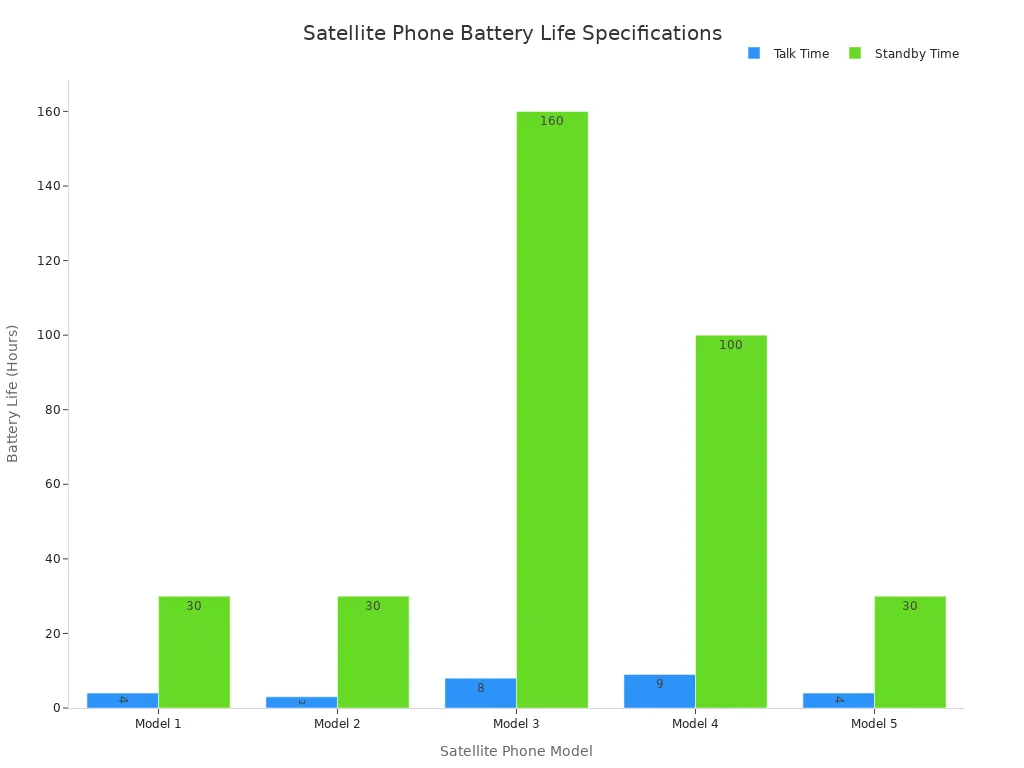
Durability is another factor. You want a phone that can handle tough conditions. Finally, consider the cost of the device and its airtime plans. These factors help you find the best satellite phone for your specific needs.
Top 10 Reliable Satellite Phones
You need a reliable device for your adventures. Here are 10 top satellite phones you can trust.
Iridium Extreme 9575
The Iridium Extreme 9575 is a tough and reliable choice. It offers talk, text, and an SOS button. You get GPS tracking. This phone is very durable. It provides unmatched global coverage, even in polar regions. Its unique Low-Earth Orbit network ensures reliable communication anywhere. This makes it one of the best satellite phones for high-latitude expeditions.
Inmarsat IsatPhone 2
The Inmarsat IsatPhone 2 is a budget-friendly option. It is often called the best cheap satellite phone. You get voice calling, text messaging, and basic data. It has a weather-resistant design and a built-in GPS. A dedicated SOS button is included. This phone offers up to 8 hours of talk time and 160 hours of standby time.
Thuraya XT-PRO DUAL
The Thuraya XT-PRO DUAL is the world’s first dual-mode, dual-SIM phone. It bridges satellite and terrestrial communications. You can use both a satellite SIM and a cellular SIM. Its “SAT and GSM Always On” function lets you make and receive calls on both networks at the same time. This provides dependable communication in remote regions.
Garmin inReach Messenger Plus
The Garmin inReach Messenger Plus is ideal for reliable wilderness communications. It uses the global Iridium® satellite network. You can send two-way text messages, photos, and even voice messages when paired with the Garmin Messenger app. It has an interactive SOS feature. This makes it the best satellite phone for sending photos and staying connected off-grid.
Iridium GO! exec
The Iridium GO! exec is a versatile satellite Wi-Fi hotspot. It also offers voice capabilities. You can connect multiple devices like smartphones and tablets. It supports voice, SMS, and email services. It has an integrated SOS function and real-time GPS tracking. This device is excellent for teams in remote areas. It is a great satellite phone and gadget for voice calling capabilities.
BGAN Explorer 510
The BGAN Explorer 510 provides fast data speeds. You get up to 464 kbps for standard IP. It supports internet browsing, email, and phone services. You can also do file transfers and use VPN applications. This terminal is perfect for those needing quick internet access in global remote locations.
Globalstar GSP-1700
The Globalstar GSP-1700 is suitable for lower-cost regional coverage. It works well in North America. It is a budget-friendly option. This phone is a good choice if your travels are mainly within its coverage areas.
Iridium 9555
The Iridium 9555 offers reliable voice communication. It has clear calls and advanced noise cancellation. You can send SMS and use basic data services. It includes GPS capabilities. This phone has military-grade durability. It features a rugged housing and is weather-resistant. It is a solid handheld satellite phone.
Thuraya X5-Touch
The Thuraya X5-Touch is the world’s first smart satellite phone. It looks like an Android smartphone. It has a large 5.2-inch full HD touchscreen. It runs on Android, so you can access many apps. It has high-quality cameras and built-in GPS navigation. This is a great satellite phone and gadget with SMS and advanced features.
ACR Bivy Stick
The ACR Bivy Stick is a compact satellite communicator. It turns your smartphone into a global satellite communicator. It offers two-way text messaging and location tracking. It has a dedicated SOS button that alerts Global Rescue. This is the best stand-alone satellite communicator for its size and features. It is also a great satellite phone and gadget with SMS.
Choosing the Right Satellite Phone Overall
Assessing Your Coverage Needs: Global vs. Regional
When you choose a satellite phone, first think about where you will travel. Do you need true global coverage, or will regional coverage work for your trips? Systems like Iridium offer unmatched global coverage, reaching even the polar regions. This is vital for expeditions to remote, global areas. Other systems, like Globalstar, provide excellent regional coverage, often at a lower cost. You must match your device’s coverage to your specific travel plans.
Budget and Airtime Plan Considerations
The cost of a satellite phone includes both the device and its service plan. A top-quality new satellite phone can cost up to $2000. Refurbished units can be found for as little as $500. For example, an Iridium 9575 might cost $999.00, while an Inmarsat IsatPhone 2 can be around $788.00. Monthly costs for satellite phones also vary. Iridium postpaid plans start at $72 per month. Inmarsat and Thuraya plans range from $50 to $150 monthly. You can find plans like $99.95 per month for 150 minutes or texts. Other plans offer 10 minutes for $64.99 per month.
Plan Name | Monthly Fee | Monthly Bundle |
|---|---|---|
Emergency Plan | $59.95 | n/a |
Economy 5 Plan | $62.95 | 5 minutes |
Seasonal 10 Plan | $66.00 | 10 minutes |
Starter 25 Plan | $73.00 | 20 minutes |
Advanced 100 Plan | $87.00 | 100 minutes |
Power 250 Plan | $108.00 | 250 minutes |
Consider these costs when choosing the best satellite phone overall for your budget.
Durability and Environmental Resistance
Your satellite phone must withstand harsh conditions. Look for devices with high IP ratings. These ratings show resistance to dust and water. Many satellite phones feature rugged designs. They handle drops and extreme temperatures. This ensures your device works when you need it most, even in the most challenging global environments.
Ease of Use and User Interface
In an emergency, you need a device that is simple to operate. Many satellite phones have compact designs for quick use. They feature SOS buttons and clear displays. The Inmarsat IsatPhone 2 offers a straightforward interface with large buttons. The Iridium GO Exec also has a user-friendly design. These features help you quickly send distress signals or make calls. As a search and rescue team member shared, “The SOS feature on the IsatPhone 2 was a lifesaver during our mountain rescue mission. It ensured that help could find us quickly when we needed it most.” This ease of use is crucial for any satellite phone overall.
Tips for Effective Satellite Phone Use

You own a powerful communication tool. Learn how to use it well. This helps you stay safe and connected.
Understanding Airtime Plans and Costs
You need to know your airtime plan. Satellite phones use different plans. Some are monthly, and some are annual. Prepaid plans offer convenience. You do not have long contracts. They work globally. You can easily add more credit online. Postpaid plans give you consistent service. You do not worry about running out of credit. Here are some typical plan structures:
Plan Type | Communication Allowance (Units) | Monthly/Annual Cost | Overage Rate (Minutes) | Overage Rate (Texts) | Contract Term |
|---|---|---|---|---|---|
Monthly | 150 | $99.95/month | $1.19/minute | $0.99/text | 12 or 24 months |
Monthly | 10 | $64.99/month | $1.19/minute | $0.99/text | 12 months |
Annual | 2500 | $2,395.00/year | $1.19/minute | $0.49/text | 1 year |
Global Prepaid | 75 | $159.00 | N/A | N/A | 14 days validity |
Best Practices for Battery Management
Your phone’s battery life is important. Optimize your signal reception. This makes your phone work less hard. It saves power. Keep your satellite phone fully charged. This gives you strong signal and top performance. A poorly optimized signal drains your battery faster. Improving signal reception extends your phone’s life. For example, an offshore oil rig worker uses a solar-powered battery pack. This keeps their phone charged. They maintain communication even during long shifts in global remote areas.
Maintaining Your Device in Harsh Conditions
Protect your device from extreme conditions. Keep it safe from very hot or cold temperatures. Also, protect it from moisture. Many satellite phones are built tough.
Model | Water Resistance |
|---|---|
Inmarsat IsatPhone 2 | IP65 |
Iridium 9575 Extreme | IP65 |
Thuraya XT-PRO | IP55 |
These ratings show how well they resist water and dust. This ensures your phone works in any global environment.
Emergency Protocols and SOS Features
You must know your phone’s emergency features. Many satellite phones have dedicated SOS buttons. A single press alerts emergency services. It sends your location. This saves time in critical situations.
Familiarize yourself with your phone’s operation. Learn how to activate emergency features. Do this before an emergency happens.
Activate the SOS feature if you face a life-threatening situation. This sends a distress signal. It includes your GPS coordinates to emergency responders. This starts a rescue.
A reliable satellite phone is essential for your safety and peace of mind. You need this device during global travel. Consider coverage, durability, cost, and features. These are key factors. Evaluate your specific global travel requirements against the 10 devices discussed. This helps you find the best satellite phone overall for your needs. Stay connected and safe on any adventure, anywhere in the world.
FAQ
What makes a satellite phone different from a regular cell phone?
A satellite phone connects directly to satellites orbiting Earth. Your cell phone uses ground-based towers. This means you can make calls from very remote areas with a satellite phone. Cell phones need a nearby tower to work.
What does “global coverage” mean for a satellite phone?
Global coverage means your satellite phone works almost anywhere on Earth. This includes oceans and polar regions. Networks like Iridium offer true global coverage. Other networks might cover specific regions. You can stay connected worldwide.
What is an SOS button on a satellite phone?
An SOS button is a special feature for emergencies. When you press it, your phone sends a distress signal. This signal includes your exact location. It alerts emergency services. This helps rescuers find you quickly when you need help.
What can you do to make your satellite phone battery last longer?
You can optimize your signal reception. Find a clear view of the sky. This helps your phone connect easily. Keep your phone fully charged before you start your trip. Turn off features you do not need. This saves power.